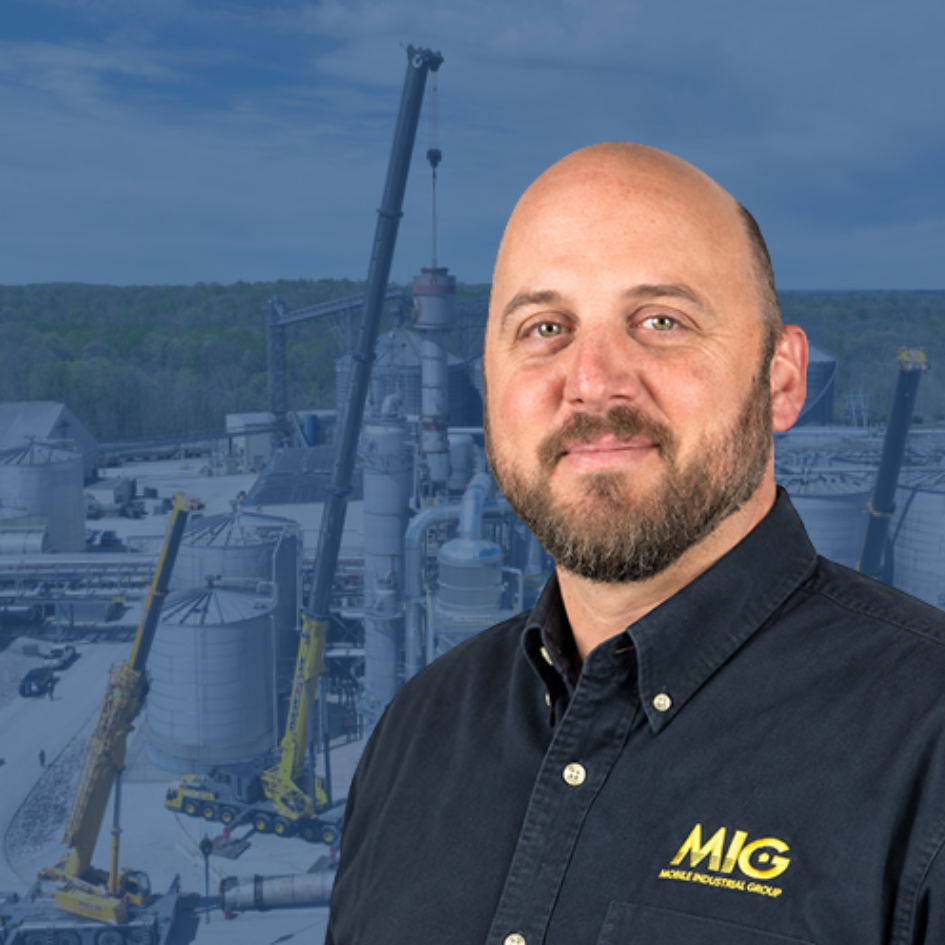
Behind the POET heat exchanger project is Aaron Wagner, twenty-two years at MIG, a two hour commute, and a habit of asking the question nobody wants to hear.
Three times, the plant told Aaron Wagner he was clear to cut into the line. Three times, he said no.
It was a vent line tie-in on a boiler installation at a customer facility, years ago. Aaron had done everything right, the line marked out, the crane rigged, the crew standing by. All he wanted before making the cut was to walk the line with someone from the plant, because he didn't know where it went. The answer kept coming back the same: you're fine, Aaron. Just cut it.
He didn't. And when he finally pressed hard enough to get a real answer, it arrived almost as an afterthought: the line ran to the plant's cyanide recovery system. Had it been rinsed? Flushed? What happens to cyanide when you put a grinder to the pipe and send it airborne? Well, the plant admitted, that's a good question.
The cut that was supposedly find ended up requiring a full rinse of the line, an abatement crew working both sides of the weld, and welders in full-face respirators. Nobody got hurt, because one person refused to stop asking.
"You gotta ask questions."
If you want to understand why customers keep calling MIG, why one of them recently trusted us with an 80,000-pound heat exchanger swap in the middle of a live distillation area, and then called back to do it all over again, that story is a better explanation than any capability statement we could write.
The Long Way to the Office
Aaron's MIG story starts in 2004, with a decision most career guides would tell you not to make. He was at Purdue studying mechanical engineering technology when he walked away to take a job at Maddox. It wasn't a leap into the unknown. The company's vice president lived in his hometown, Aaron had grown up with his kids, and his cousin Brad was already six years into his own Maddox career. He knew the people. He liked what they built.
What followed was the long apprenticeship the industry doesn't really make anymore: heavy equipment, certified welding, the pipe fitting program, millwright work, wastewater, concrete, a little bit of everything, as he puts it. Within four years he was a foreman. When Maddox was still a small crew breaking into air separation work, Aaron ran most of those projects himself.
The office kept asking him to become a project manager. He kept turning it down, not out of modesty, but strategy. He wanted more years in the field first, so that when he finally sat across from a crew and asked them to do something hard, no one would wonder whether he'd ever done it himself.
"When I take on that role, I want people to be comfortable with what I tell them. When I ask them to do something, they know I'm asking from experience."
He made the move in 2017. Today he manages MIG's ethanol work and projects across the northern half of Indiana, with jobs reaching into Ohio and Texas, and he still drives two hours each way to do it. Ask him why he's stayed twenty-two years and he doesn't reach for anything grand. He talks about loyalty, about the guys he works with, about liking to see how things get made. “When I commit to something,” he says, “that's what I stay at.”
The Saturday Phone
Aaron has worked with POET facilities since 2013, and at some of those plants the relationship has compressed into a single sentence. The phone rings, and the voice on the other ends says: "Hey Aaron, I got this job, just do it."
That sentence took a decade to earn. It's built on the unglamorous things: showing up, answering the phone on a Saturday and making something work, sending crews who know the plant well enough to catch an isolation problem before a line break becomes an incident. More than once, MIG people have stopped work at a customer site because something didn't add up, and been proven right.
So when POET needed its heat exchangers replaced, the biggest of them hanging in the most volatile corner of the plant, where the alcohol runs at nearly 200 proof, they didn't shop the job around. They called the people who already knew the building. And when the same equipment needed replacing again, they made the same call.
"Our name is on that job. When the next person looks at it, we want them to know Maddox did it, and that it was good work."
The Other Wagner
Aaron will not let this story end without sharing the credit, and the first name out of his mouth is Brad Wagner, his cousin, MIG superintendent, and, in Aaron's flat assessment, "the best pipe fitter we have." Brad joined Maddox straight out of high school in 1998 and came up through the pipe fitting program. On the POET project, he superintended the piping while Aaron ran the rigging, the two of them working permit by permit, line break by line break, alongside plant personnel.
Plants ask for Brad by name. He drops everything to make sure POET is taken care of, and he walks every job with the same standard: the world should still speak well of Maddox long after the crew has gone home.